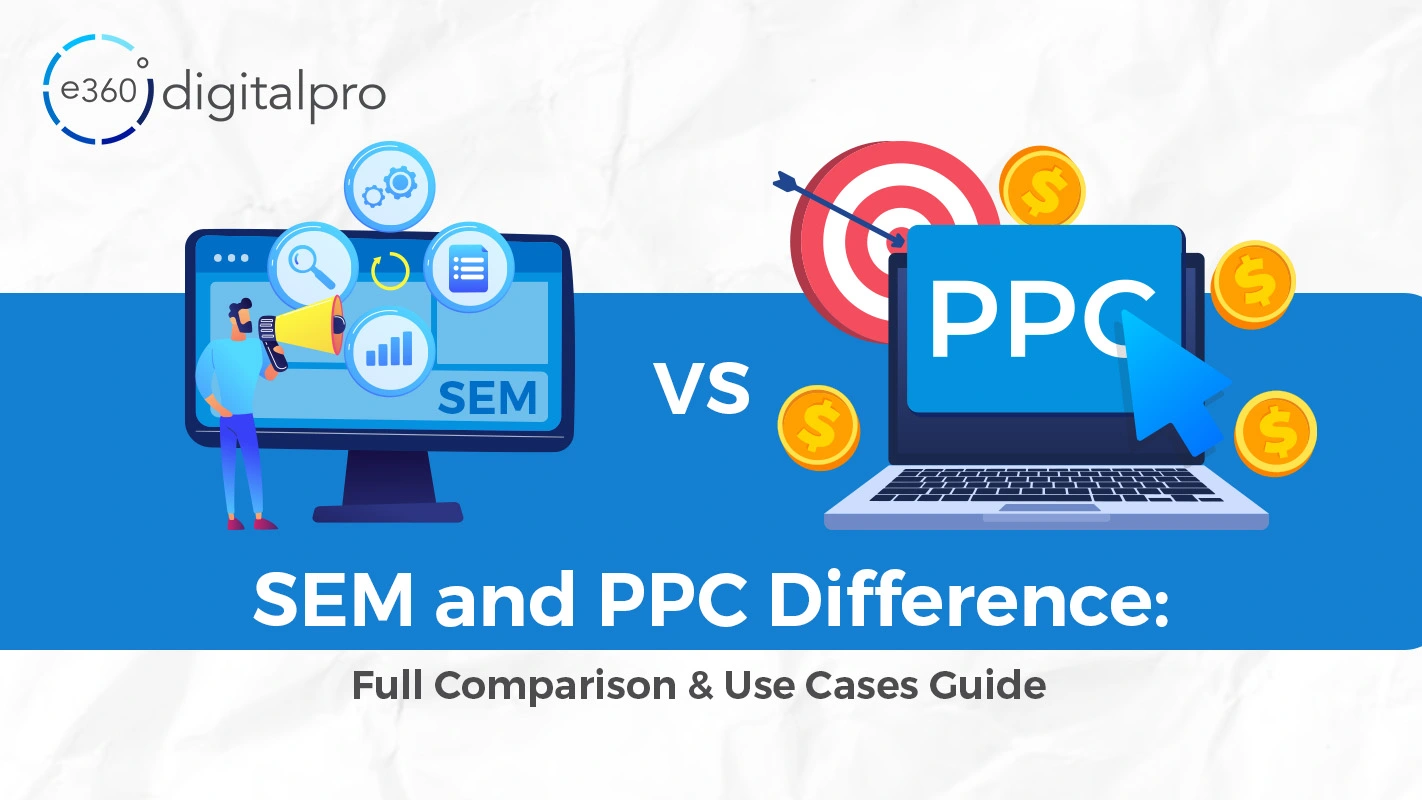
If you’ve ever Googled “how to get more traffic”, or sat in a digital marketing meeting, you’ve probably heard the terms SEM and PPC tossed around… sometimes kind of like they’re the same thing. But they aren’t. Knowing the SEM and PPC difference is one of those core basics in digital marketing, and if you mix them up, you can end up with wasted budget and a blurry plan.
What Is SEM and PPC? Definitions First
What Is SEM?
SEM means Search Engine Marketing. Its a wide umbrella term that covers any approach aimed at getting attention on search engine results pages, you know, SERPs. Historically, SEM included both paid search and also organic methods, but nowadays a lot of marketers use SEM as shorthand for paid search marketing only.
What Is PPC?
PPC stands for Pay-Per-Click. This is a pricing model, not really a channel. In PPC you pay whenever someone clicks your ad, no matter where that ad shows up. So that could be on Google, Facebook, YouTube, LinkedIn, or even a news website.
To answer what is SEM and PPC, if somebody says “SEM pay per click”, they’re usually talking about a Google Ads campaign where you bid on keywords and pay for every single click the ad gets. In that case it’s both SEM (because it is on a search engine) and PPC (because you pay per click).
A Facebook ad campaign is PPC too, because yes you pay per click, but it doesn’t have anything to do with search engines so it is not SEM. That’s basically the main SEM and PPC difference.
Also Read: How to Choose a Mobile App Development Company – A Full Checklist
How Can PPC Help Your Business?
Let’s get down to business. How can PPC help your business in a way? Here are some real benefits:
- Immediate Visibility: Unlike SEO, which can take months, a PPC campaign can get you to the top of Google within hours of launching.
- Precise Audience Targeting: With PPC you can target by keyword, location, device, time, demographics, interests and past actions.
- Full Budget Control: You can set limits on how much you spend each day and month so you never go over budget.
But understanding how can PPC help your business also means seeing its boundaries, so let’s talk about the advantages and disadvantages too.
Advantages and Disadvantages of PPC
No strategy is totally perfect. There’s always a give and take, so here’s a more balanced look at advantages and disadvantages of PPC:
Advantages
- Speed: Outcomes are almost instant. You launch a campaign today, get clicks tomorrow, like it’s nothing.
- Scalability: You can raise the budget and reach more individuals without starting over, again and again.
- A/B testing: You can run several ad variations at once and refine based on live numbers.
- Brand visibility: Even the clicks that don’t turn into conversions still help with awareness, and that sense of familiarity.
Disadvantages
- Cost: Those popular keywords can get really pricey, like, CPCs (cost-per-click) in legal, insurance, and finance often landing around $10 to $50+ … yeah.
- No lasting value: The second you stop spending. The visitors stop too. And unlike SEO, PPC doesn’t build any long-term organic “equity” or anything similar.
- Click fraud: Bots and sometimes rival advertisers clicking your ads can bleed your budget, especially if the campaigns aren’t watched with enough attention.
- Ad fatigue: When people keep seeing the exact same ad, they start basically dismissing it. So creative refresh becomes a never-ending, recurring requirement, in practice.
Weighing out the advantages and disadvantages of PPC honestly is key for deciding how much budget to allocate, and also whether you really need professional SEM & PPC services to manage campaigns effectively. Sometimes it feels simpler to do it in-house, but then again, the risk of wasted spend can creep in.
Also Read: Healthcare App Development Cost: Full Pricing Guide 2026
SEM & PPC Services: What Do Agencies Actually Do?
When you hire an agency for SEM and PPC services this is what you are usually getting, in words but also a bit complicated:
- Keyword research and strategy: Finding the right search terms that balance search volume, what the user wants and how many other people are trying to be found for those terms.
- Campaign set up and structure: Building clean(ish) ad groups, match types, plus some careful bidding strategies.
- Ad copy writing: Crafting headlines and descriptions, so the ads actually get clicks not just impressions.
- Bid management: Tweaking bids in real time, based on performance signals and data trends.
- Analytics and reporting: Watching to see how many people are taking action how much money is being made and what it is costing then making sense of it all.
- Ongoing A/B testing: Always trying to make the ads and the pages they link to better one small step at a time to get the best results, from Search Engine Marketing and Pay Per Click services.
Common Questions About SEM PPC
Q1. What is the main SEM and PPC difference in simple terms?
Search Engine Marketing is a way to advertise on search engines like Google using paid ads. Pay-Per-Click is a way to pay for these ads, where you pay each time someone clicks on your ad. The main SEM and PPC difference are that Search Engine Marketing is about where you put your ads. Search Engine Marketing is like a place where you show your ads. On the other hand, Pay-Per-Click is about how you pay for these ads.
Q2. Do I need an agency for SEM PPC campaigns, or can I manage them myself?
You can manage search engine marketing pay per click campaigns yourself with Google Ads but the learning curve is pretty steep if I am honest. When Google Ads campaigns are not optimized well Google Ads campaigns can waste a large chunk of your budget really fast, like too fast, for comfort
Also Read: Is SEO Worth It for Small Business? Marketing ROI Explained
Final Thoughts
The SEM and PPC difference really come down to this, like, SEM is the channel side (search engines), and PPC is the payment model (pay per click). Whether you are starting out with a small Google Ads budget or you’re scaling into a full multi channel paid strategy, knowing the SEM and PPC difference helps you ask better questions, set clearer targets, and squeeze more value from every dollar you spend
Grow Faster With e360Digital Pro
Ready to launch a high performing SEM and PPC campaigns that actually deliver results? e360Digital Pro helps you build data driven paid search strategies that fit your business objectives in a smart way.